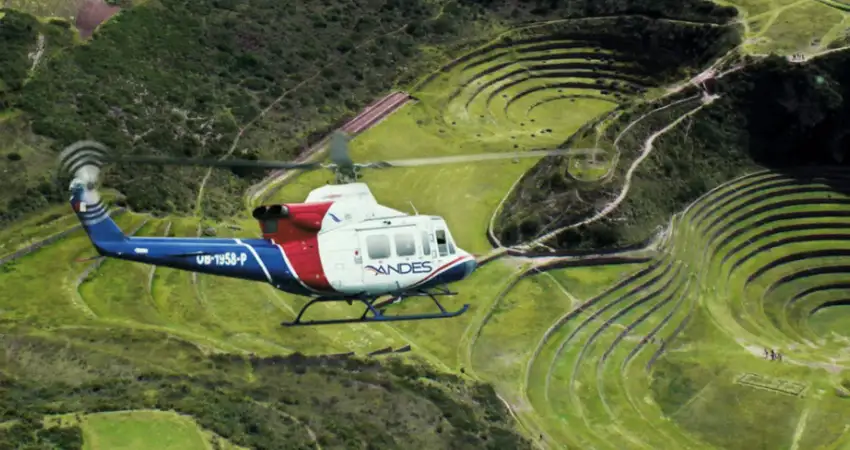
Helicopter tours represent one of the most exclusive ways to experience the Cusco region and Sacred Valley, offering aerial perspectives of Inca ruins, snow-capped Andean peaks, and dramatic geological formations that remain inaccessible from ground level. Given the region’s elevation and limited infrastructure, these tours require careful planning, realistic expectations regarding costs, and awareness of important safety considerations and environmental restrictions.
Tour Pricing and Cost Structure
Helicopter tours in Cusco operate on a charter basis, with pricing determined by aircraft type, flight duration, group size, and current fuel costs. This results in variable pricing rather than fixed rates, though established operators provide consistent price ranges.
The most affordable option is the Cusco City tour, spanning $2,000–$3,500 for a group of up to five passengers, covering 15–45 minutes of flight time. This route provides aerial views of the Plaza de Armas, the sacred Qoricancha temple, colonial cathedrals, and the imposing Sacsayhuaman fortress overlooking the city. The price variation depends on whether you opt for the shorter, quicker circuit or the extended experience with more detailed navigation over archaeological sites.
The Maras & Moray experience, priced at $3,600–$4,900 for 30–60 minutes, takes travelers over the dramatic Sacred Valley landscape, including the ancient salt mines of Maras with their distinctive geometric pools and the agricultural terraces of Moray, which served as Inca crop laboratories. Additional sights include the lagoons of Huaypo and Piuray, and the town of Chinchero.
Sacred Valley tours represent a significant step up in price and duration at $5,400–$7,950 for 60–90 minutes, combining elements of shorter routes with more extensive coverage. These comprehensive flights traverse the Pisac archaeological complex and its terraced slopes, the snow-capped Andes exceeding 6,000 meters, and lesser-known Inca sites such as Huchuy Qosco.
The premium offering is the Rainbow Mountain (Vinicunca) tour, costing $6,600–$8,900 for 80–115 minutes of flight time. This demanding route ventures into the remote South Valley near Pitumarca, ascending toward the geologically striking 7-Color Mountain with its bands of mineral-rich hues, while also covering the Red Valley and the Ausangate Glacier.
Operators such as Kondor Path Tours and Peru VIP Travel offer comparable pricing, with some packages—particularly the Rainbow Mountain and Sacred Valley routes—reaching $8,450–$8,550 for extended chartered flights.
Available Routes and Highlights
| Route | Duration | Key Highlights | Price Range |
|---|---|---|---|
| Cusco City | 15-45 min | Sacsayhuaman, Qoricancha Temple, Plaza de Armas, cathedrals | $2,000-$3,500 |
| Maras & Moray | 30-60 min | Salt mines, agricultural terraces, Huaypo and Piuray lagoons | $3,600-$4,900 |
| Sacred Valley | 60-90 min | Pisac ruins, Andes peaks (6,000m+), Huchuy Qosco, Chinchero | $5,400-$7,950 |
| Rainbow Mountain | 80-115 min | 7-Color Mountain, Red Valley, Ausangate Glacier, South Valley | $6,600-$8,900 |
| Humantay Lagoon | 75 min | Turquoise alpine lake, snow-capped peaks, photography opportunities | ~$7,500-$8,500 |
| 7-Color Mountain | Variable | Vinicunca, Red Valley, Bosque de Piedras rock formations | $6,600-$8,900 |
Critical Limitation: Machu Picchu is Off-Limits
A crucial restriction for prospective tourists is the complete prohibition on helicopter flights over Machu Picchu and its buffer zone, imposed by the Cusco provincial government in 2010. This ban exists to protect endangered wildlife, including spectacled bears, Andean cock-of-the-rock birds, guanacos, and vicuñas. Helicopter operations are permitted only for medical emergencies or national security situations, and even then require prior authorization from Peru’s Culture Directorate and SERNAP (National Service of Natural Protected Areas).
Aircraft and Safety Standards
Most operators in Cusco employ the Airbus H125 (also known as AS 350 B3) or the Bell 505, twin-engine helicopters specifically engineered for high-altitude, challenging terrain operations. The Airbus H125 offers capacity for five passengers plus a pilot, with a maximum cruising speed of 147 knots and a powerful Turbomeca Arriel 2 turbine engine designed to perform reliably in thin mountain air. Both aircraft types comply with Peruvian Civil Aeronautics Authority certification, requiring operators to maintain rigorous safety protocols, maintenance schedules, and crew training standards.
Weight restrictions apply universally: the maximum combined weight for a group of four to five passengers is 400 kilograms (approximately 880 pounds). This ensures proper aircraft balance and safety margins at high elevations. Tour operators conduct weight verification during the booking process, and passengers should disclose any weight-related concerns in advance.
What to Expect During Your Flight
Pre-Flight Experience
Hotel pickup typically occurs 1–2 hours before departure, allowing time to reach Velasco Astete International Airport (Cusco’s primary airport). Some operators include hotel transportation in their packages, while others require separate arrangement. Upon arrival at the heliport, you’ll undergo a brief safety briefing covering seatbelt usage, emergency procedures, communication protocols via headsets, and photography guidelines. Operators offering photo-focused tours provide composition tips and positioning advice before boarding.
During the Flight
Helicopter tours provide unobstructed 360-degree views through bubble windows or open side panels, with pilots trained to prioritize passenger comfort and photo opportunities. Flight noise is significant but managed through headset communication systems, allowing passengers to hear pilot commentary in English or Spanish. Most operators adjust flight paths and altitude based on weather conditions, passenger comfort, and specific interests—if you’re particularly interested in a certain site, communicating this to the pilot beforehand ensures optimal coverage.
The ride itself varies with aircraft type and weather. Modern helicopters offer smooth flight characteristics, but passengers should anticipate:
- Altitude ascent effects: Flying from Cusco’s elevation of 3,399 meters (11,152 feet) to even higher altitudes above the Andes can intensify altitude-related symptoms. While the flight itself involves minimal additional climbing, those not acclimated to Cusco’s altitude may experience mild headaches, dizziness, or shortness of breath.
- Motion sensitivity: Helicopter motion differs significantly from fixed-wing aircraft. Turbulence, thermal winds off mountain slopes, and banking maneuvers can trigger nausea in sensitive passengers. Strategies to minimize motion sickness include requesting forward-facing seating near the cockpit, maintaining hydration, consuming peppermint candies or citrus lozenges, and employing controlled breathing techniques.
- Visual intensity: The panoramic views are exceptional but can feel overwhelming. The sheer scale of the Andes, the geometric precision of Inca terraces, and the vivid colors of geological formations create a sensory experience unlike ground-level tourism.
Post-Flight
Return to your hotel typically occurs 2–4 hours after departure, accounting for check-in, flight time, and ground transportation. You’ll receive digital photos if using a photo-focused tour operator. Most flights depart and return to your hotel with flexible timing, allowing integration into broader daily itineraries.
Altitude and Health Considerations
Cusco’s elevation of 3,399 meters (11,152 feet) presents the primary health challenge for most visitors. While helicopter flights themselves don’t ascend dramatically higher, passengers must already be acclimatized to Cusco’s altitude before undertaking a tour. Medical authorities recommend a minimum 48–72 hour acclimatization period before undertaking strenuous activities or helicopter flights.
Approximately 30% of sea-level visitors to Cusco experience some degree of altitude sickness (soroche), ranging from mild headaches to serious high altitude cerebral edema (HACE) or high altitude pulmonary edema (HAPE) in extreme cases. To minimize risk:
- Arrive in Cusco at least 2–3 days before scheduling your helicopter tour
- Remain hydrated throughout your stay and on the day of your flight
- Avoid alcohol and sedating medications, which exacerbate altitude effects
- Consult a physician before traveling if you have a history of altitude sickness, sleep apnea, heart conditions, or lung diseases
- Travelers over 70 years old should provide a medical certificate confirming good health
If you develop symptoms—persistent headache, dizziness, nausea, or shortness of breath—prior to your scheduled flight, postpone the tour. Medical evacuation by helicopter from remote locations during a flight emergency is possible but costly and dependent on weather conditions. Verify that your travel insurance covers high-altitude medical emergencies and helicopter evacuation, as costs are typically the passenger’s responsibility.
Optimal Timing and Weather
The dry season (May–September) offers the most reliable flying conditions and clearest aerial views, with June–August representing peak tourist season. However, April–May and October–November provide an excellent balance: fewer tourists, pleasant weather, minimal rain, and stable atmospheric conditions. The wet season (December–March) features afternoon rainstorms that can cancel or delay flights, though morning departures often succeed. Additionally, the post-rain landscapes feature vibrant vegetation and occasional rainbow phenomena, and accommodation and tour prices typically decrease.
Weather volatility is significant. Mountain valleys create unpredictable wind patterns, and afternoon thermal activity can increase turbulence. Most operators schedule flights for early morning departures (6–8 AM) when atmospheric conditions are most stable. If weather deteriorates, reputable operators will reschedule your flight rather than risk safety, so building flexibility into your itinerary is prudent.
Practical Booking Considerations
Advance Booking
Helicopter tours should be booked 1–2 weeks in advance during shoulder seasons and 2–4 weeks ahead during peak season (June–August). This ensures aircraft availability and allows operators time to coordinate with airport authorities and conduct safety preparations.
What to Bring
- Layers of lightweight clothing (temperatures at higher altitudes drop approximately 6°C per 1,000 meters of elevation)
- Sunscreen and UV-protective sunglasses (UV exposure increases dramatically at altitude)
- A water bottle for hydration
- Camera equipment (ensure it is secured and does not interfere with safety protocols)
- Medications for altitude sickness if recommended by your physician
- Passport (required for airport access)
Cost Management
The per-person cost decreases when sharing with larger groups. A city tour for one person costs approximately $400–$700 per person (splitting the full charter), while more expensive routes see per-person costs of $1,200–$1,800 when shared among five passengers. Solo travelers should ask operators about scheduled group departures or request to be matched with other tourists.
Conclusion
Helicopter tours in Cusco deliver unparalleled aerial perspectives of one of the world’s most geologically and archaeologically remarkable regions. Prices range from $2,000 to $8,900 depending on route and duration, with most tours accommodating five passengers maximum. The Sacred Valley and Rainbow Mountain routes represent the highest value for time and visual intensity, though the simpler Cusco City tour provides memorable views at lower cost. Critical success factors include arriving with proper acclimatization, booking during favorable weather windows (May–September or April–May/October–November), and selecting an operator certified by Peru’s Civil Aeronautics Authority. Most importantly, understand that Machu Picchu helicopter flights are prohibited—all tours focus on alternative Inca sites, geological formations, and the Andean landscape itself.